
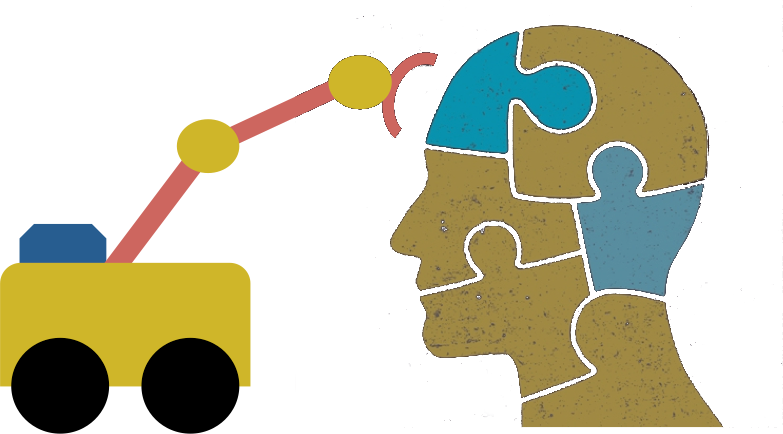
Four thrusts, one collaboration problem
Each thrust below addresses a different facet of what it takes for a robot to work well alongside a person: reading their state, deciding how to act around them, adapting to them over time, and communicating with them efficiently.
- 01
Perception and Modeling
The lab builds perception methods aimed at inferring human mental and emotional states for collaborative robotics, going beyond conventional computer vision. This includes designing model representations of human behavior and cognitive state that remain trainable on datasets that are small, noisy, or incomplete.
1 project → - 02
Decision Making
We develop decision-making and planning systems that weigh a human teammate's physical and mental condition when selecting robot actions. A central goal is interpretability: robot behavior should read as legible and unobtrusive to the people working alongside it, which shapes our work on human-aware planning and decision modules.
2 projects → - 03
Learning and Adaptation
This thrust studies how robots can learn human preferences and adapt to them during collaborative work, while accounting for the fact that humans adapt in turn. The aim is mutual learning techniques that support fluent, long-term interaction between robotic and human teammates rather than one-shot preference inference.
1 project → - 04
Communication
We investigate communication modalities beyond conventional interfaces, asking what information actually needs to be conveyed between robot and human teammates. The lab explores minimal, context-sensitive communication strategies that stay human-aware without overloading the interaction.
1 project →
A second, cross-cutting way to look at the same work: grouped by who is collaborating with whom, rather than by research method.
- A
Human-Robot Systems
Modeling humans and making robot decisions that account for a human teammate.
3 projects → - B
Robot-Robot Systems
Coalition formation and coordination for tightly coupled multirobot tasks.
6 projects → - C
Multi-Agent Systems
Task allocation, required cooperation, and distributed pathfinding across agent teams.
3 projects →