Human-Robot Systems
Modeling humans and making robot decisions that account for a human teammate.
← All research areas- Human Modeling
Capability Modeling
The tasks in human modeling include enabling automated systems to learn about the humans they work with in terms of knowledge, capabilities, intents, and preferences.
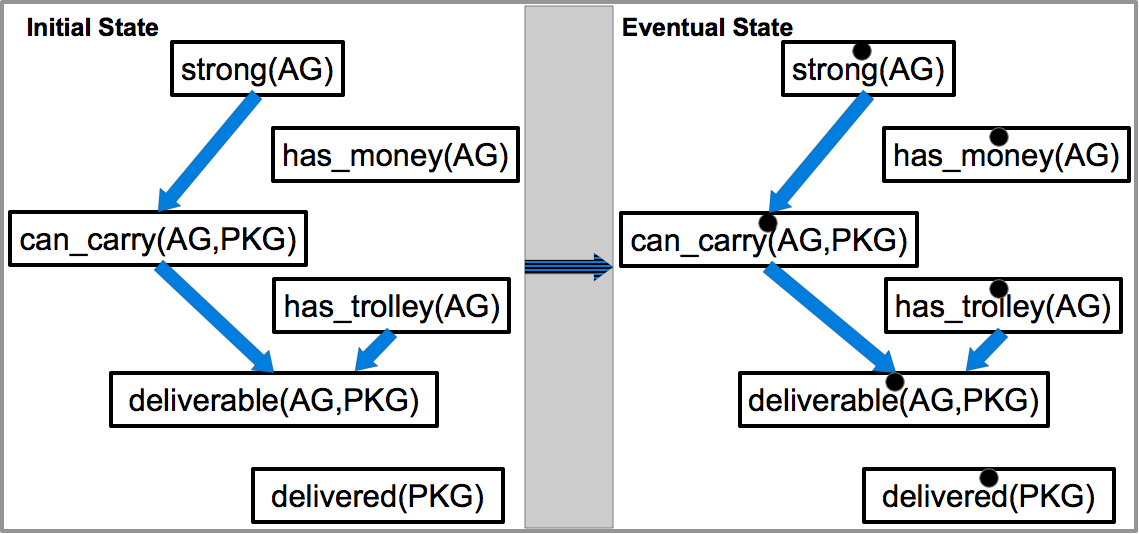
One important challenge for a set of agents to achieve more efficient collaboration is for these agents to maintain proper models of each other. An important aspect of these models is that they are often not provided, and hence must be learned from plan execution traces. As a result, these models of other agents are inherently partial and incomplete. Most existing agent models are based on action modeling and do not naturally allow for incompleteness.
We introduce a modeling approach based on the representation of capabilities, which has several unique advantages. First, we show that the structures of capability models can be learned or easily specified, and both model structure and parameter learning are robust to high degrees of incompleteness in plan traces (for example, with only start and end states partially observed). Furthermore, parameter learning can be performed efficiently online via Bayesian learning. While high degrees of incompleteness in plan traces present learning challenges for traditional, complete models, capability models can still learn to extract useful information. As a result, capability models are useful in applications where traditional models are difficult to obtain, or where models must be learned from incomplete plan traces, such as robots learning human models from observations and interactions.
- Human-Aware Decision Making
Planning for Serendipity
The tasks in human-aware decision making are to enable intelligent systems to interact efficiently with humans while considering models of those humans.
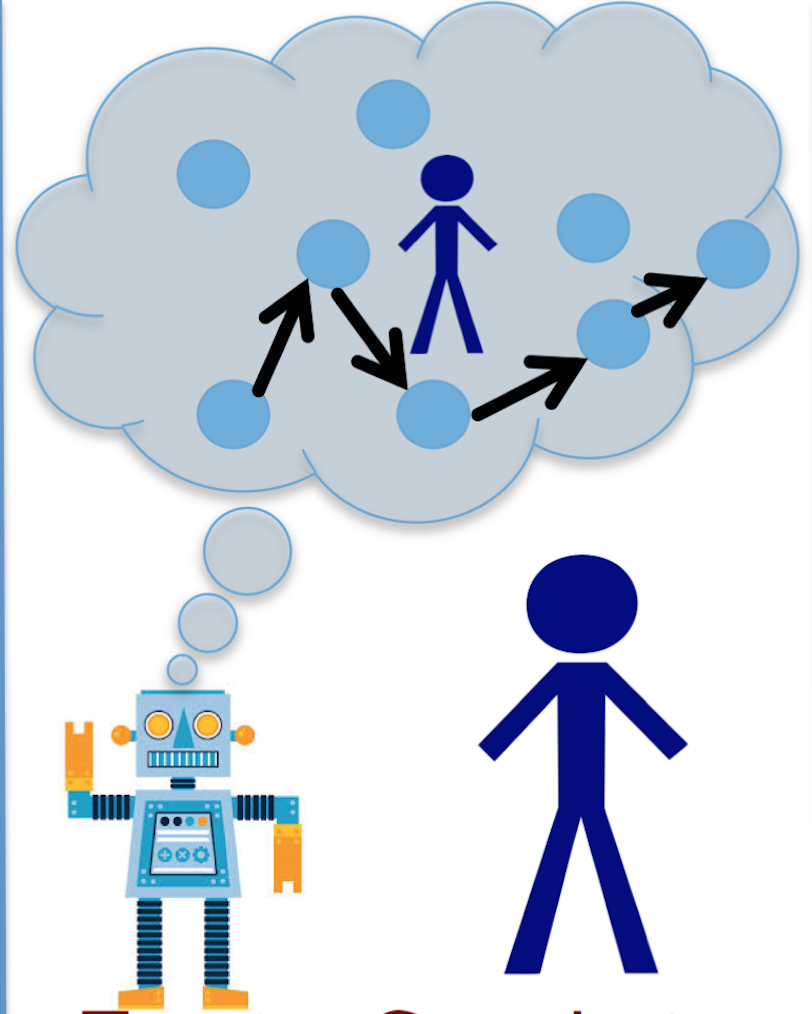
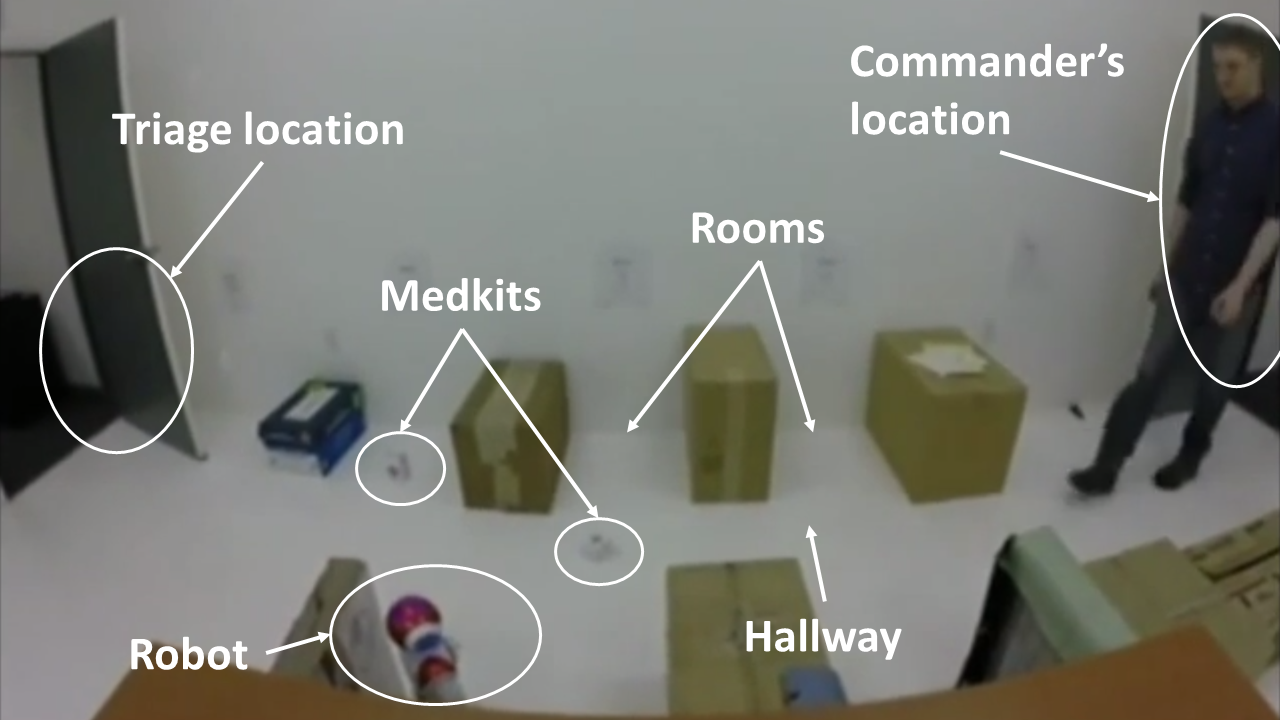
There has been a lot of focus on human-robot cohabitation issues that are often orthogonal to many aspects of human-robot teaming, such as producing socially acceptable robot behaviors and de-conflicting plans of robots and humans in shared environments. An interesting offshoot of these settings that has largely been overlooked is the problem of planning for serendipity: planning for stigmergic collaboration without explicit commitments between agents in cohabitation. In this project, we formalize this notion of planning for serendipity for the first time and provide an integer-programming-based solution. We illustrate the different modes of this planning technique on a typical urban search and rescue scenario, and show a real-life implementation of the ideas on a Nao robot interacting with a human colleague.
- System Evaluation
Proactive Assistance
The tasks in system evaluation are to assess how well human-aware systems actually perform once they’re deployed with real teammates, rather than assumed from theory alone.
It has long been assumed that for effective human-robot teaming, it is desirable for assistive robots to infer the goals and intents of humans and take proactive actions to help them achieve those goals. However, there had not been a systematic evaluation of the accuracy of this claim. On the face of it, there are several ways a proactive robot assistant can in fact reduce the effectiveness of teaming: it can increase the cognitive load of the human teammate by performing actions that are unanticipated, and misinterpretations or delays in goal and intent recognition due to partial observations and limited communication can also reduce performance.
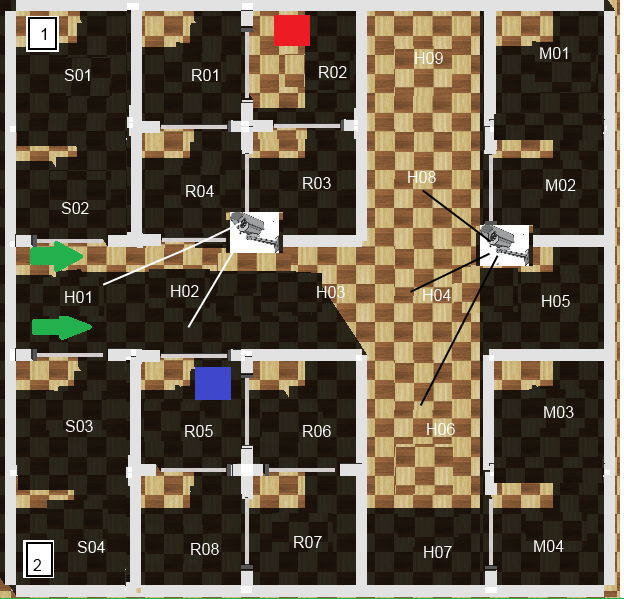
In this project, we perform an analysis of human factors on the effectiveness of proactive support in human-robot teaming, evaluated in a simulated urban search and rescue task in which the efficacy of teaming depends not only on individual performance but also on how teammates interact with each other. In this task, the human teammate remotely controls a robot while working with an intelligent robot teammate.